
The moment your brain files the paperwork to quit
At kilometre 18 of a half marathon, something strange happens.
Your legs are still moving. Your lungs are still pulling air. Your glycogen stores, by any physiological measure, have not run out. And yet, somewhere between your ears, a very convincing voice starts drafting a resignation letter.
This is too hard. You have done enough. Nobody will judge you for slowing down.
I have felt this exact moment in races. I felt it at the Tata Mumbai Marathon, somewhere on a pre-dawn stretch of road, arms still moving, bib still pinned, brain already halfway to the exit.
And I have felt the identical sensation in conference rooms, in project reviews, in the quiet moments before a difficult stakeholder call.
The wall is not a running problem. The wall is a decision problem. And most leaders, like most amateur runners, are completely unprepared for it when it arrives.
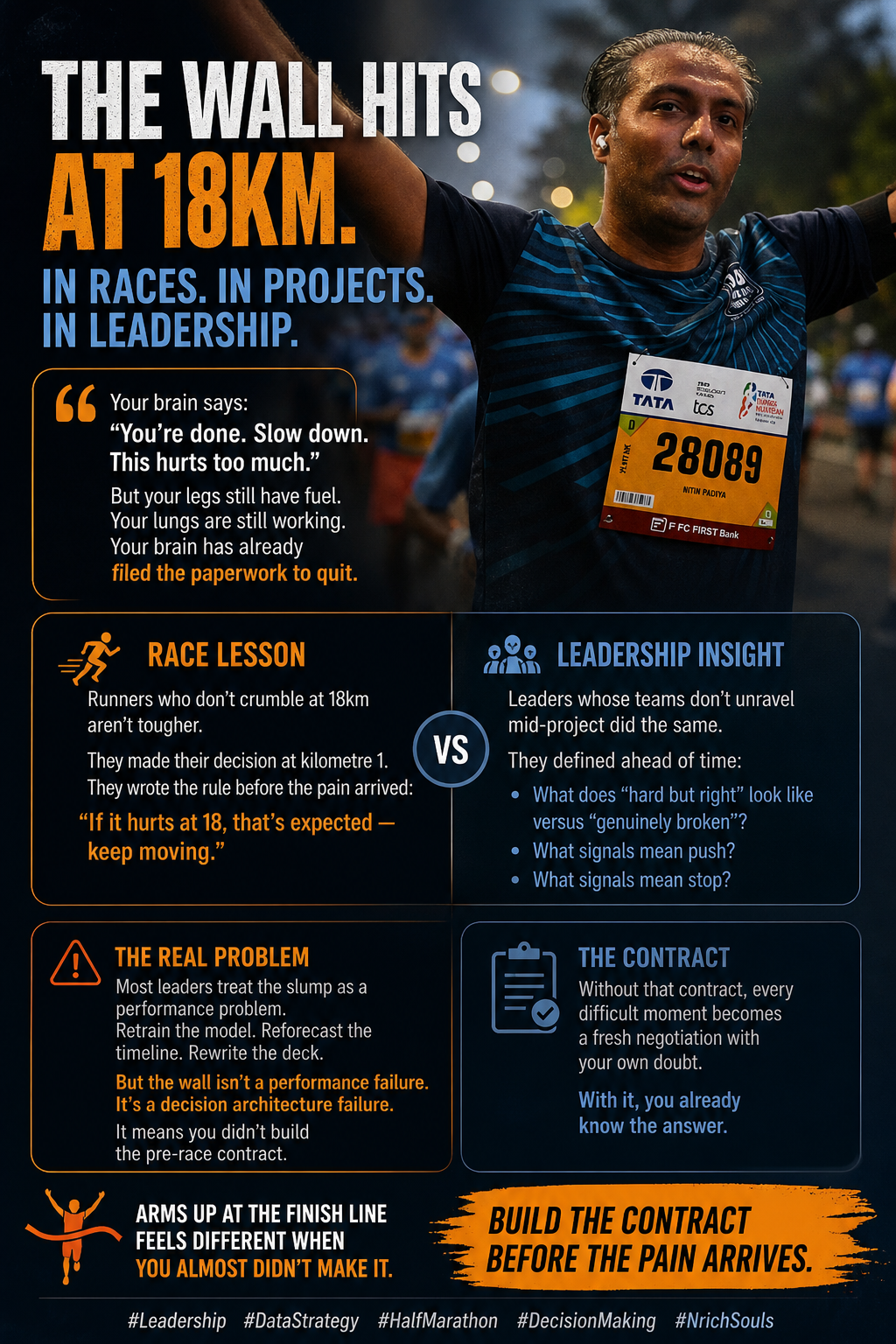
Why smart people crumble at the 18km mark
Here is the uncomfortable truth about the wall: it does not care how talented you are.
I have seen sharp data scientists abandon good models three weeks before they would have worked. I have watched capable project managers recommend a full reset on initiatives that needed one more push, not a pivot. I have been in rooms where the collective decision was to slow down, dressed up in professional language like "recalibrate," "rebaseline," or "take stock."
These are not failures of skill. They are failures of pre-commitment.
The human brain, under sustained pressure, becomes a very unreliable narrator. It reframes difficulty as danger. It confuses discomfort with dysfunction. It takes the fact that something is hard and constructs an entirely plausible story about why stopping is the rational choice.
At 18km, the pain is real. But the conclusion the brain draws from that pain — that you should stop — is a fabrication. Your body has more. Your brain just got there first with a better story.
This is exactly what happens in a mid-project slump. The signals are real: the model is underperforming, the timeline has slipped, the stakeholder energy in the room has shifted. But the conclusion — that the project is broken — is often a story, not a diagnosis. And without a framework built before the pressure arrived, you have no way to tell the difference.
The pre-race contract: a decision architecture for hard moments
The runners who do not crumble at 18km are not superhuman. They are not tougher, or more pain-tolerant, or built differently.
They made their decision at kilometre 1.
Before the race, in the calm before the discomfort, they wrote a rule: If it hurts at 18km, that is expected. That is not information. Keep moving. If I am injured, that is different. Here is what injury looks like versus fatigue.
This is what I call the pre-race contract. And it is the most underused leadership tool I know.
The pre-race contract is not a project plan. It is not a risk register. It is a specific, honest agreement you make with yourself and your team before the hard part arrives, about what hard is supposed to feel like, and what the decision rules are when it does.
A good pre-race contract answers three questions:
What does "hard but right" look like? Define the expected discomfort. In a data project, this might be: model performance will plateau in weeks three and four before the feature engineering cycle completes. That is not failure. That is the process.
What does "genuinely broken" look like? Be specific about the actual stop signals. Not "stakeholders are unhappy" — that is always true somewhere. Instead: if we cannot access the core data source by week six, or if the business requirement has fundamentally changed, those are real stop signals.
Who makes the call, and when? Ambiguity in governance is what turns discomfort into panic. Decide in advance who holds the decision, and what information they need to make it. Do not negotiate this at 18km.
What this looks like in practice
At Mercer, I lead teams working on AI systems across insurance and healthcare analytics. The mid-project wall is a near-universal experience. A claims risk model that looked clean in development starts behaving oddly on live data. A renewal decision engine surfaces edge cases the business did not anticipate. A benchmarking product hits a data quality issue that was invisible until it was not.
Every time, the instinct in the room is to treat this as evidence that something is wrong with the project.
Sometimes it is. But often, it is just 18km.
The teams that navigate this well are not the ones with the best technical skills, though that matters. They are the ones who had the pre-race conversation early. They documented what normal turbulence looks like. They agreed on the difference between a signal and noise. They built the decision architecture before they needed it.
The teams that struggle are the ones who arrive at the hard moment without a contract. Every difficult data point becomes a fresh referendum on whether to continue. Every stakeholder question feels like an indictment. The absence of a pre-built framework turns discomfort into doubt, and doubt into drift.
The arms-up moment only means something if you almost didn't make it
There is a photograph from the Tata Mumbai Marathon that I keep coming back to. Arms raised, somewhere in the dark, still moving. What the photo does not show is what happened at kilometre 18.
The conversation with myself. The negotiation. The moment I chose to treat the pain as information rather than instruction.
That is the finish line that matters. Not the physical one. The internal one, where you decide whether your pre-race contract is worth more than your brain's very convincing case for stopping.
Leadership is full of 18km moments. The project that is hard but not broken. The team that is stretched but not failing. The strategy that is uncomfortable but correct.
The question is not whether the wall will come. It will, every time.
The question is whether you built the contract before the pain arrived.
If you did, you already know what to do.
Arms up. Keep moving.
Nitin Pandya writes about AI, data systems, leadership, and the uncomfortable truths that connect all three. Follow NrichSouls for more.