
There is a number buried inside a report released this week that should make every Indian business leader uncomfortable.
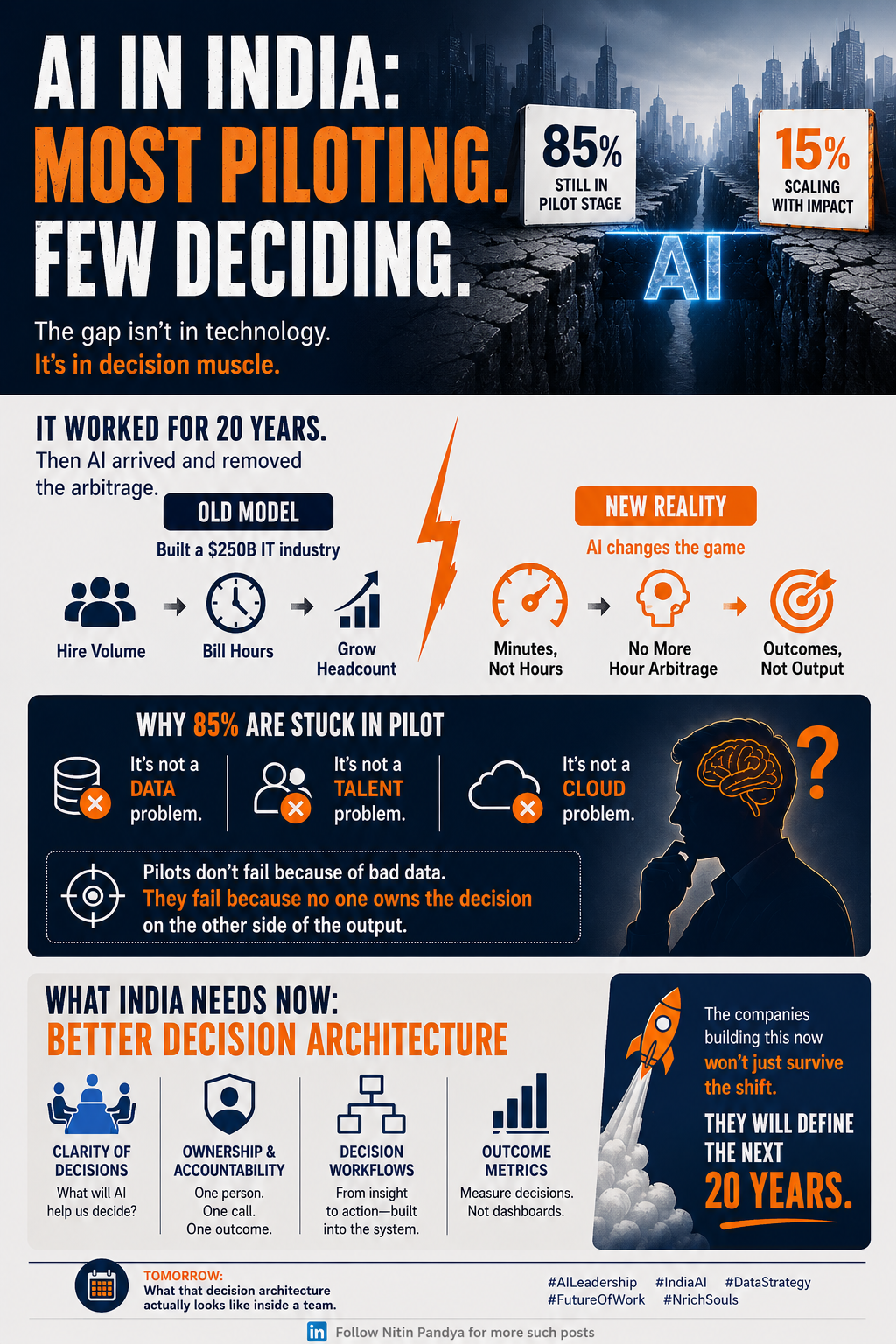
According to a joint study by IBM and IndiaAI published on May 13, 2026, only 15% of Indian organisations are currently scaling AI through significant cross-functional investments. The remaining 85% are still running pilots.
Eighty-five percent.
That is not a technology statistic. That is a leadership one.
And until Indian boardrooms are honest about that distinction, no amount of GPU investment, no sovereign AI fund, and no summit with Sam Altman and Sundar Pichai in the same room is going to move that number.
The Model That Built India Inc Was Never Designed to Decide
Let us go back twenty years.
India's IT boom was a masterpiece of arbitrage. Talented engineers, lower wages, strong English fluency, and a time zone that let you service American clients while they slept. The formula was elegant: hire volume, train for delivery, bill by the hour, scale by headcount.
It worked spectacularly. India built a $250 billion IT industry on the back of it. Millions of families moved into the middle class. Cities like Bengaluru and Hyderabad rewrote their identities around it.
But here is what that model never had to develop: decision architecture.
You did not need to decide when the work was defined by the client. You did not need to take risk when the contract protected your margin. You did not need judgment when the metric was utilisation.
For two decades, Indian enterprises built organisations optimised for execution, not decision-making. And that was fine. Until the thing that arrives and automates execution is the very thing you are now supposed to adopt.
AI Did Not Create the Gap. It Revealed It.
When a pilot fails to scale, the post-mortem almost always blames one of three things: data quality, talent shortage, or infrastructure gaps. The IBM study confirms this — 57% of respondents cite uneven data quality as a barrier, and 77% point to cloud infrastructure gaps.
These are real problems. But they are not the root problem.
The root problem is this: most Indian organisations do not have a clear owner for the decision that sits on the other side of an AI output.
Think about what a pilot actually is. You build a model. It produces an output — a risk score, a churn prediction, a pricing recommendation. And then what? Who acts on it? With what authority? Against what success metric? With whose budget?
In most pilots, the answer to all of those questions is: unclear.
The model becomes a dashboard. The dashboard becomes a slide in a quarterly review. The quarterly review produces a recommendation to "explore further." And the pilot lives on, undead, consuming data science bandwidth and delivering nothing.
This is not an AI problem. This is an accountability architecture problem.
The 15% Are Not More Technical. They Are More Decisive.
The companies scaling AI in India are not the ones with the best models. They are the ones where a senior leader has drawn a line in the sand and said: this output changes how we act, starting now.
That sounds simple. It is not.
It requires the organisation to accept that an algorithm can be more reliable than accumulated human intuition in specific, bounded decisions. It requires middle management to give up the comfort of "I will review this and decide" and replace it with "the system flags it, I handle exceptions." It requires leadership to fund not just the model, but the workflow redesign around it.
In insurance, this plays out in claims and renewals constantly. A model can flag a suspicious claim with 87% accuracy. But if the claims handler still needs three approvals to act on that flag, the model is decoration. The decision architecture has not changed. Only the input has.
Scaling AI means redesigning who decides, not just what data they use.
What Decision Architecture Actually Looks Like
It is not complicated, but it is uncomfortable.
It starts with a single question before any pilot is approved: if this model works perfectly, what decision changes, who owns that change, and what happens to the person who was making that call before?
That last part is where most organisations flinch. Because redesigning decision architecture means redistributing authority. And redistributing authority is political, not technical.
The organisations doing this well have a few things in common. They have an executive sponsor accountable for the outcome, not just the output. They define success as a business metric — loss ratio improvement, renewal rate, customer resolution time — not a model accuracy score. And they build for exception handling first, because that is where human judgment still earns its place.
The ones stuck in pilot mode are doing the opposite. They are measuring model performance in isolation, celebrating proof-of-concept demos, and calling it AI transformation.
It is not transformation. It is theatre.
The Real Opportunity in the 85%
Here is the contrarian read on that IBM number.
85% stuck in pilot mode is not just a problem. It is an asymmetric opportunity.
The companies that build decision architecture now — that do the uncomfortable work of redesigning who acts on what, with what authority, against what outcome — will not just close the gap with global peers. They will leapfrog organisations that scaled AI on top of broken decision systems and are now paying the price in bad outputs nobody trusts.
India has done this before. We skipped landlines and went straight to mobile. We skipped branch banking and went straight to UPI. The willingness to redesign the system rather than retrofit the old one is in our institutional DNA.
The question is whether Indian business leadership will apply that same instinct inward — to their own decision-making structures — before the window closes.
The technology is ready. The data is getting there. The missing piece has always been the courage to decide differently.
Nitin Pandya writes about AI, decision systems, and the business of insurance at NrichSouls. He leads Data and AI at Mercer, working with global clients on turning data into better decisions.