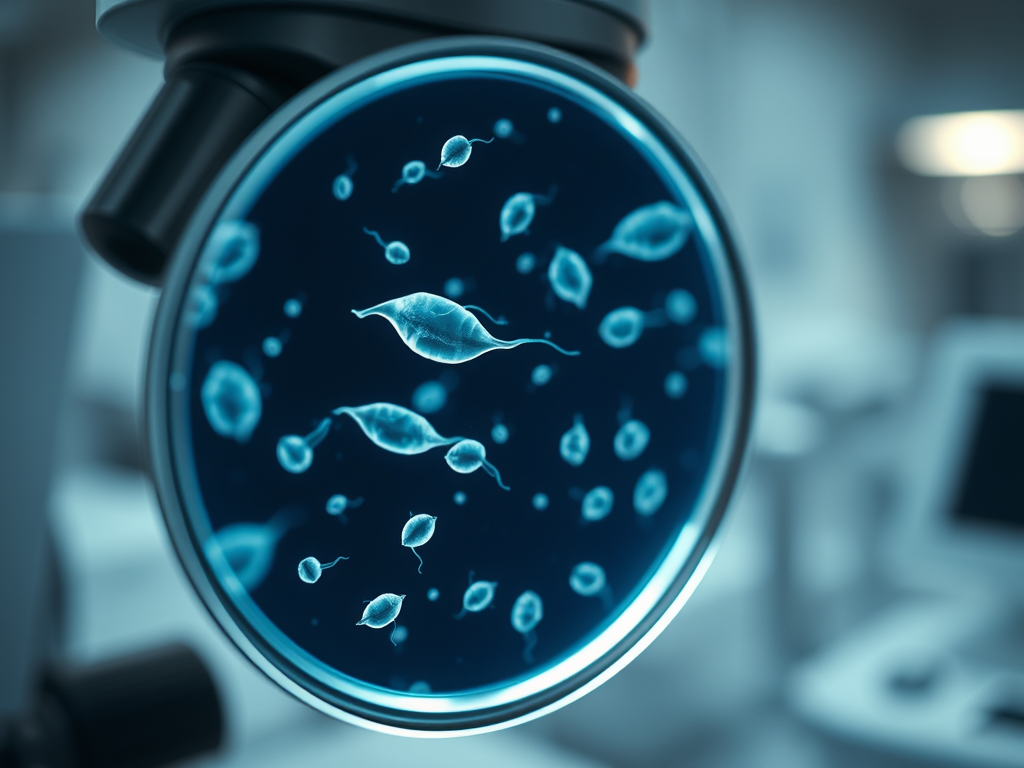
“We weren’t just looking for a needle in a haystack. We were looking for a living, swimming needle—so small it can hide from the human eye.”
That’s how one embryologist described the painstaking and heartbreaking process of finding viable sperm. The challenge is especially significant in men with azoospermia. This is a condition where sperm are either absent or so few. As a result, conventional IVF techniques often fall short.
For years, couples facing male infertility had limited, invasive, and often unsuccessful paths to parenthood. But in 2025, a quiet but seismic shift occurred in a lab at Columbia University.
Meet STAR: the AI-powered tool that isn’t just finding sperm. It’s finding hope.
The Hidden Crisis of Male Infertility
Infertility affects 1 in 6 couples globally. While female factors often take center stage, male infertility contributes to nearly 50% of all cases. Among the most severe forms is non-obstructive azoospermia (NOA)—where sperm production is virtually non-existent.
Fertility experts traditionally use surgical retrieval to find sperm in samples. They conduct extensive lab work. They even use toxic dyes to detect the elusive sperm hiding in these samples. It can take hours, sometimes days. Many times, they find nothing.
That’s not just a biological defeat. It’s an emotional and financial burden. It’s years of waiting, hoping, trying—only to be told: there’s nothing we can do.
But STAR changes the story.
What Is STAR?
STAR stands for Sperm Tracking and Recovery—a system that blends artificial intelligence, microfluidic technology, and high-resolution microscopy.
Dr. Zev Williams and his team at Columbia University created STAR. It is modeled on techniques used in astrophysics to identify faint celestial bodies. Astronomers scan millions of pixels to find new stars. Similarly, STAR analyzes 8 million images per hour. It finds what the human eye misses: motile, healthy sperm—even when there are just a handful in an entire sample.
No dyes. No surgeries. No guesswork.
Just precision, powered by machine learning.
The Breakthrough That Made History
In March 2025, STAR was put to its biggest test.
A couple who had been trying to conceive for 19 years came to Columbia after dozens of failed IVF cycles. The husband had NOA, and embryologists had already spent 48 hours trying to find sperm in his sample—unsuccessfully.
Then came STAR.
Within under an hour, it found 44 viable sperm. That’s all the lab needed.
Through a process called Intracytoplasmic Sperm Injection (ICSI)—where a single sperm is injected directly into an egg—the couple conceived.
By June 2025, the pregnancy was confirmed and progressing normally.
It was the first pregnancy ever made possible by AI-based sperm discovery. But experts believe it won’t be the last.
How It Works (In Simple Terms)
- Sample is loaded into a microfluidic chip—like a tiny maze designed to guide sperm gently through.
- A camera records footage at 25 frames per second, capturing microscopic movement across millions of frames.
- STAR’s AI algorithm processes these images in real-time, flagging and tagging potential sperm candidates.
- Using micromanipulators, lab techs retrieve the sperm—gently, without chemicals or damage.
- Fertilization proceeds via ICSI, the same way as in traditional IVF.
It’s like Google Maps for sperm—zooming in, scanning roads, highlighting rare moving vehicles, and sending a ping when one’s found.
Why This Matters Beyond One Couple
The implications of STAR go far beyond one miracle pregnancy.
1. Access Without Surgery
Most men with NOA undergo testicular biopsies to extract sperm—a painful and often unproductive procedure. STAR can potentially make that obsolete.
2. Faster IVF Cycles
Instead of spending 20+ hours scouring slides, labs can get results in 1–2 hours with STAR. That’s more cycles, less burnout, and faster decisions.
3. Emotionally Sustainable
Repeated IVF failure is a mental health crisis in disguise. Knowing there’s a smarter, sharper tool looking for life where humans might miss it brings back a sense of hope.
Beyond Sperm: The Future of AI in Fertility
While STAR currently focuses on sperm detection, its creators see a bigger horizon:
- Healthier Sperm Selection: Beyond locating them, STAR could rank sperm based on quality and motility.
- AI for Egg & Embryo Viability: Similar tools could help assess embryo strength and likelihood of implantation.
- Automated IVF Labs: Future fertility clinics might run AI-based analysis from sample to selection with minimal human bias or fatigue.
Think of it as the evolution from microscopes to microscanners—from tired eyes to tireless algorithms.
Real Talk: Is It Ready for the Masses?
Not quite—yet.
STAR is still being used in controlled lab environments. It requires sophisticated imaging, custom software, and trained embryologists to handle micromanipulation.
But the signs are promising:
- Hundreds of STAR-assisted cases have already occurred at Columbia University.
- Fertility experts around the world are calling it “a revolution in lab work.”
- Regulatory bodies are watching closely—but cautiously.
What’s clear is this: The first spark has been lit.
What This Means for You (or Someone You Know)
If you or someone you love is facing infertility—especially male-factor infertility—here’s what to know:
- Ask your fertility clinic if they’ve heard of AI-based sperm detection systems.
- Follow research labs like Columbia’s Center for Reproductive Medicine for updates.
- Most importantly, don’t give up hope. The landscape is changing—faster than we ever imagined.
And with tools like STAR, what once felt impossible is now within reach.
Final Thoughts: A Star Is Born—Literally
AI is being debated for replacing artists, writers, and workers. However, it’s quietly transforming another field entirely: the creation of life.
STAR isn’t flashy. It doesn’t have a humanoid face or a viral TikTok video. But it’s one of the most human uses of AI we’ve seen.
Because in the end, what could be more human than helping a child be born?
👣 Ready to Explore More?
- Share this story with someone who needs hope.
- Stay tuned for deeper dives into AI-powered medicine.
- Follow our blog for updates on next-gen fertility breakthroughs.
And remember: sometimes, the smallest things—barely visible, easily missed—hold the greatest power to change everything.


Leave a Reply